 By Naman Gundaniya
AI Agent vs Chatbot vs Workflow: What Is the Difference?
A chatbot answers a message and waits for the next one. A workflow runs a fixed sequence of steps that a developer wrote in advance, with a model doing some of them. An AI agent is given a goal and chooses its own steps and tools until the job is done. The difference is who decides what happens next, and that sets the cost, the risk and the testing effort.
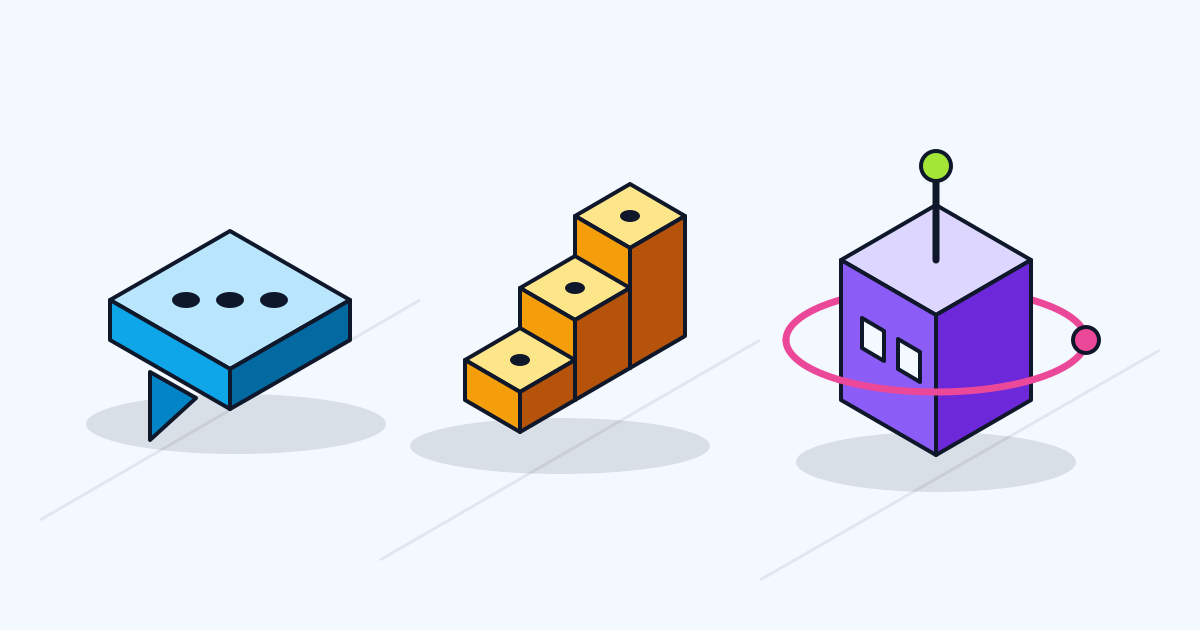
Buyers hear all three words for the same product, sometimes in the same sales call. That makes quotes hard to compare, because the three things differ a great deal in what they cost to build and run. This post gives a plain test for telling them apart and rules for choosing between them.
What is the difference between a chatbot, a workflow and an AI agent?
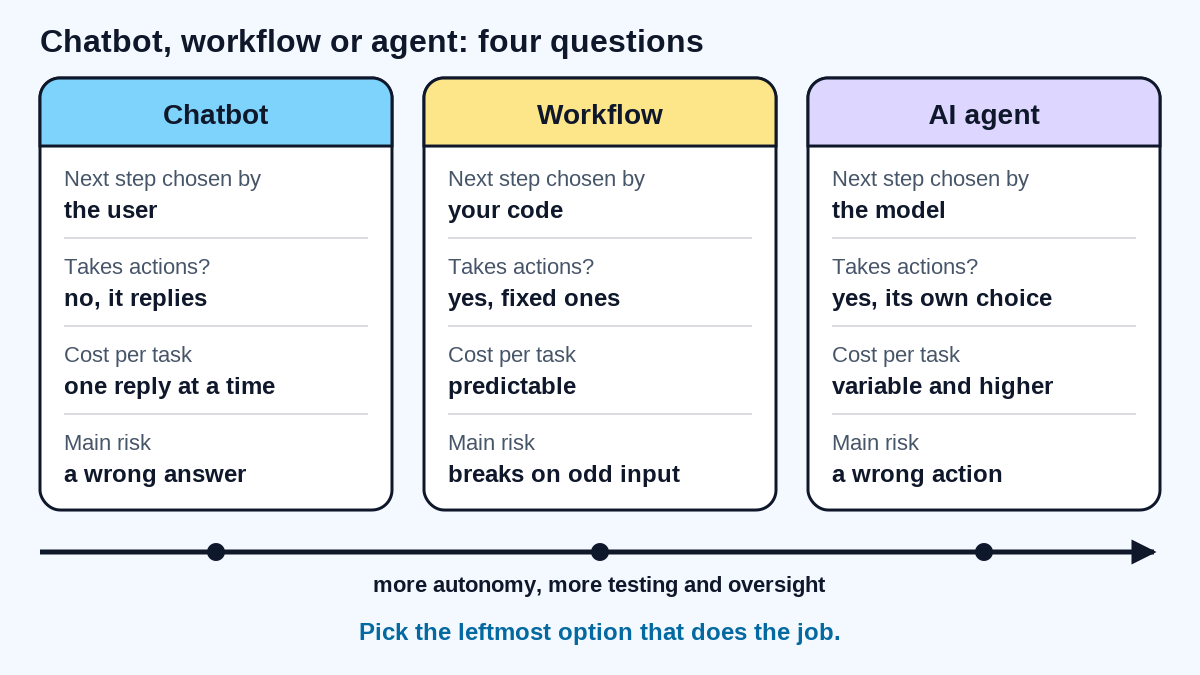
The difference between a chatbot, a workflow and an AI agent is who decides the next step: the user, the code or the model. Everything else in the table follows from that.
| Chatbot | Workflow | AI agent | |
|---|---|---|---|
| Who decides the next step | The user, one message at a time | Your code, written in advance | The model, at run time |
| Acts on other systems | Usually not; it replies with text | Yes, through the steps you wired in | Yes, by choosing from its tools |
| Same path every run | One turn at a time | Yes | No |
| Cost per task | One model call per reply | A known number of model calls | Variable; grows with the steps taken |
| Typical failure | A wrong or invented answer | Stops on input nobody planned for | A wrong action, or a long wrong route |
| How you test it | Check answers against sources | Check each step | Evaluate whole runs and set limits |
The workflow and agent columns follow the definitions Anthropic uses in Building effective agents: workflows are "systems where LLMs and tools are orchestrated through predefined code paths", and agents are "systems where LLMs dynamically direct their own processes and tool usage". For a fuller definition with examples, see what an AI agent is.
A short example makes it concrete. A customer writes "where is my order?".
- A chatbot explains how to track an order and links to the tracking page.
- A workflow extracts the order number, calls the order system, and sends a templated status reply. It does this the same way every time.
- An agent looks up the order, sees it is stuck at customs, checks the policy, offers a replacement or a refund, and opens a ticket for the warehouse. Nobody scripted that exact sequence.
Where does the line between them blur?
The line blurs because real products combine all three, and vendors' own tools reflect that. A chatbot that can call tools and decide which to use over several steps is an agent with a chat window. A workflow with one model step that classifies a request is still a workflow.
Vendor documentation is more careful than vendor marketing on this point. Anthropic groups workflows and agents together as "agentic systems". The CrewAI documentation separates Flows, which handle state and control flow, from Crews, which are teams of autonomous agents, and recommends starting a production application with a Flow and using a Crew inside a step only when the task needs one. Google's Agent Development Kit documentation describes graph workflows that pair model reasoning with deterministic code.
The useful question for a buyer is therefore not "is it an agent?" but "which parts are fixed, and which parts does the model decide?". A good supplier can answer that with a diagram.
How do cost and risk change from chatbot to workflow to agent?
Cost and risk both rise with autonomy, because an agent takes more model calls per task and can take actions nobody reviewed in advance. Anthropic states the trade directly: agentic systems "often trade latency and cost for better task performance".
On running cost, the best public figure comes from Anthropic's June 2025 post on its multi-agent research system: agents typically use about four times more tokens than chat interactions, and multi-agent systems about fifteen times more. The same post says multi-agent systems need tasks where the value is high enough to pay for the extra performance. A workflow has one advantage over both: the number of model calls per task is fixed, so the monthly bill can be forecast from volume.
On build cost, the model calls are the small part. An agent needs evaluation sets that score whole runs, limits on steps and spend, logging of every tool call, and approval steps for sensitive actions. A chatbot needs good source content and a way to say "I don't know". A workflow needs error handling for the inputs it was not designed for.
On risk, the type of failure changes. Anthropic notes that the autonomous nature of agents brings "the potential for compounding errors", where an early mistake shapes every later step. A chatbot's mistake is a sentence someone can ignore. An agent's mistake can be an email sent or a record changed. The mechanics do give you a place to put a check: in OpenAI's function calling guide, the application, not the model, executes each tool call, so an approval step can sit between the model's request and the action.
Which one should a buyer choose?
A buyer should choose the least autonomous option that does the job, and move right only when a real requirement forces it. Anthropic gives the same advice to engineers: find "the simplest solution possible", and only increase complexity when needed. These are the rules I apply on client projects.
- If people need answers from your content, build a chatbot. Product questions, policies and documentation fit here. My website chatbot build guide covers what makes one accurate.
- If the steps are known and repeat, build a workflow. Invoice processing, lead routing and report generation follow the same path every time. Tools such as those in n8n vs Zapier vs Make are often enough.
- If the steps differ case by case and mistakes can be undone, consider an agent. Research, triage and drafting are good candidates, with a narrow set of tools.
- If a wrong step is expensive, add approvals or keep a person in charge. Payments, deletions and messages to customers should not depend on a model's unreviewed choice.
- If two options would work, pick the simpler one. You can add autonomy later. Removing it after an incident is harder.
One more check helps when comparing quotes. Ask each supplier five questions:
- Which tools can the system call, and which of them change data?
- Which actions need a person's approval?
- What is the maximum number of steps, and the maximum cost, for one task?
- How is it tested before release, and against what examples?
- What does the user see when it fails?
A supplier selling a real agent will have specific answers. A supplier selling a chatbot under the name "agent" will not, and that is useful to know before you compare prices. If the answer is a real agent, the next question is how it is built, which I cover in AI agent frameworks compared.
Can one product combine a chatbot, a workflow and an agent?
One product can combine a chatbot, a workflow and an agent, and a well-designed support or operations system usually does. The chatbot answers questions that documentation can settle, a workflow handles routine requests such as resending an invoice, and an agent takes only the cases that need investigation across several systems.
The design work is in the hand-offs. A router, often a single model call that classifies the request, decides which path a message takes. Routing is one of the standard workflow patterns in Anthropic's guide. Each path then has its own budget and its own tests. The agent's tools are limited to what the investigation cases need, and anything that changes customer data goes through an approval.
Building in this order keeps spending honest. The aim is for the chatbot and the workflows to carry the routine volume at a predictable cost, with the expensive path reserved for the cases where flexibility earns its price. If usage data later shows that the agent path is rarely taken, you have learned that cheaply.
Work with me
I build chatbots, workflows and agents for teams abroad, working remotely from India, and I will tell you when the simpler option is the right one. See AI chatbot development and AI agent development, or browse my work and book a scoping call to compare the options for your case.
Frequently asked
Is an AI agent just a chatbot with tools?
Partly. Adding tools is necessary but not sufficient. A chatbot that can look up one fact when asked is still mostly a chatbot. It becomes an agent when the model decides for itself which tools to use, in what order, across several steps, to reach a goal.
Is an automation in n8n, Zapier or Make an AI agent?
Not by default. A scenario with fixed steps is a workflow, even when one step calls a language model. It contains an agent only if a model inside it is given tools and chooses its own sequence of actions. Ask which of the two you are being sold, because the testing and the running cost differ.
Are AI agents more expensive to run than chatbots?
Generally yes. Anthropic reported in June 2025 that agents typically use about four times more tokens than chat interactions, because each task involves several model calls and tool results. Whether that is worth paying depends on the value of the task the agent completes.
Can I start with a chatbot and turn it into an agent later?
Yes, and it is a sensible order. Keep the knowledge sources, the tool integrations and the conversation interface separate from the start. You can then give the model one tool at a time, with approval steps, and measure whether each addition helps.
Sources
Related services
Building something like this?
Naman Gundaniya takes on full-stack and AI projects: fixed quote after a free 30-minute scoping call, replies within 24 hours.
Get in touch