 By Naman Gundaniya
NZ's IPP3A Rule and AI Agents That Pull Third-Party Data
Since 1 May 2026, New Zealand's IPP3A requires an agency that collects personal information about someone from a third party to take reasonable steps to tell that person, unless an exception applies. AI agents that enrich leads, sync CRMs or pull records from partners now need to track where each piece of personal data came from and send or justify a notice.
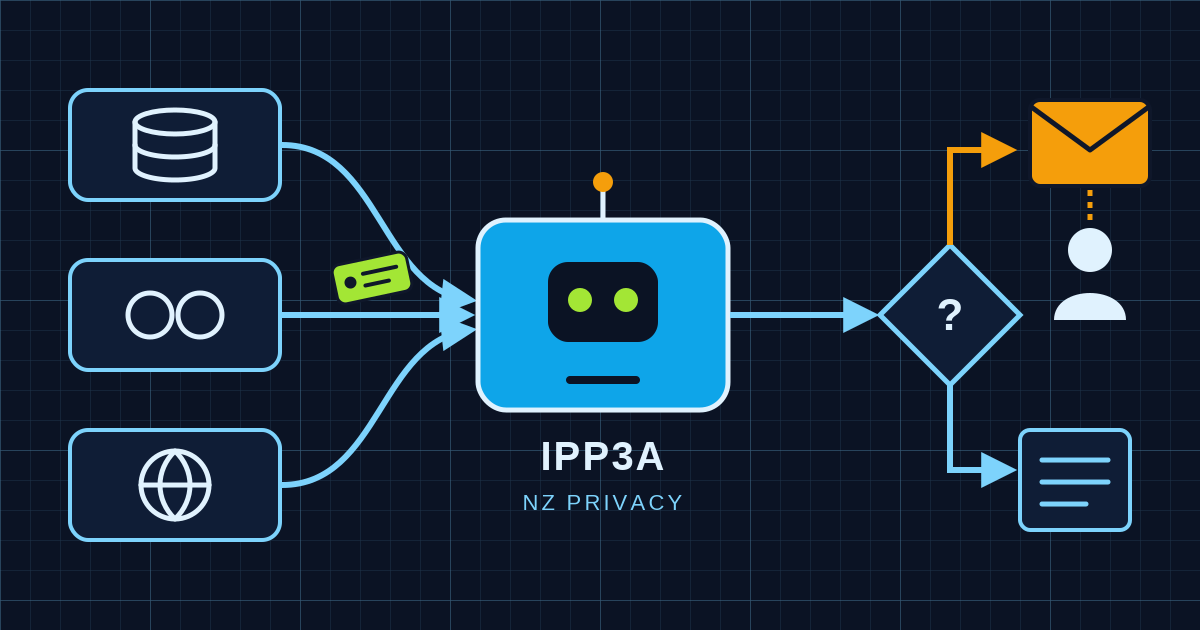
New Zealand added a new information privacy principle in 2025, and it lands squarely on the kind of automation teams are building with AI. An agent that looks up a prospect, merges a partner's spreadsheet or copies contacts between systems is often collecting personal information indirectly. Before IPP3A, nobody had to tell the person. Now, in many cases, someone does.
This post is general information from an engineer's point of view, not legal advice. It explains what the rule says, which agent patterns it touches, and the design I use to make notices a property of the pipeline rather than an afterthought.
What is IPP3A and when did it start?
IPP3A is a notification duty for indirect collection, added to the Privacy Act 2020 by the Privacy Amendment Act 2025. The Office of the Privacy Commissioner (OPC) says it came into force on 1 May 2026 and applies when an agency collects personal information "from someone other than the person themself". The amending Act received Royal assent on 23 September 2025, and the same law firm notes that IPP3A "will not apply to personal information collected before that date".
Unless an exception applies, the OPC guidance says the agency must take reasonable steps to make the person aware of:
- the fact that the information has been collected,
- the purpose of the collection,
- the intended recipients,
- the name and address of the agency collecting and holding it,
- the law authorising or requiring the collection, if there is one,
- their rights to access and correct the information.
The timing is "as soon as reasonably practicable after the information has been collected", and an agency that delays should be able to justify the delay and record its reasoning. The OPC also says cost and inconvenience on their own do not excuse notification.
Which AI agents and pipelines does IPP3A touch?
Any automation that brings in personal information about a person from somewhere other than that person is a candidate. With AI agents, that covers a lot of ground, because the point of many agents is to fetch context from other systems.
| Agent pattern | Where the personal data comes from | Likely IPP3A position |
|---|---|---|
| Lead enrichment agent | Data vendors, partner lists, other companies | Indirect collection; notice likely needed unless an exception fits |
| CRM sync between your own tools | Your own earlier collection | Usually not new collection, if the person was already told |
| Partner or referral intake | A referring business | Indirect; can be covered by the referrer's notice if it names you |
| Web research on public pages | Public websites and registers | "Publicly available" exception may apply, but not to private social media |
| Document intake (claims, forms) | Third parties writing about the person | Indirect; the OPC's insurance example is this case |
| Processor on a client's behalf | The client's data, not used for your purposes | The client stays responsible, per the OPC |
Two OPC examples map neatly onto agent work. In one, an insurer asks a car repairer for its view of a claimant, which is indirect collection about the claimant. In another, a provider that only holds data on a client's behalf is not collecting it for its own purposes, so the client remains responsible. If you build agents for clients, that second example usually describes you: the client is the agency, and your job is to give them a pipeline that makes compliance practical.
The "publicly available" exception deserves care. The OPC lists books, public registers and public websites as examples, and explicitly excludes private social media. An agent that reads a company's public team page sits differently from one that reads a closed profile, and the pipeline should know which is which.
What does an IPP3A-aware pipeline look like?
The pattern is simple: tag every personal record with its source at the moment it enters the system, decide at that point whether a notice is due, and either queue the notice or log the exception with a reason. The model never decides this on its own; ordinary code does, using the tags.
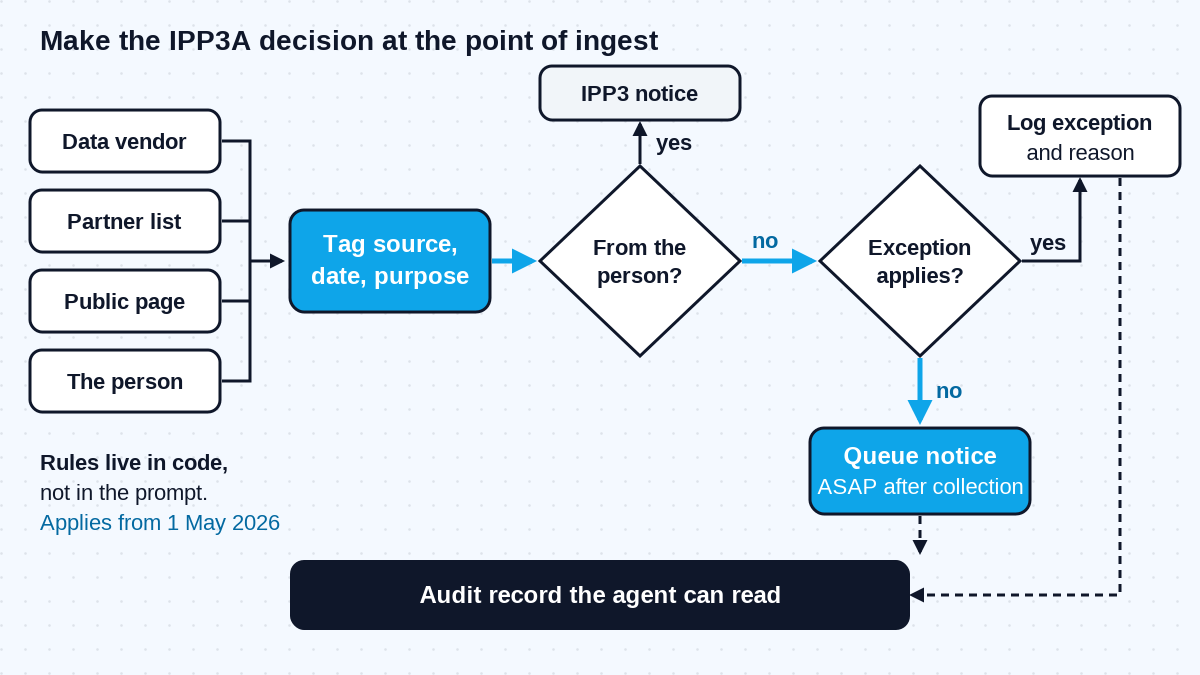
On client projects I break it into five pieces:
- Provenance at ingest. Every record that contains personal information carries a source, a collection date and a purpose. If you cannot answer "where did this email address come from?" from the database, you cannot comply with IPP3A at scale.
- A rules step, not a prompt. A small, testable function decides between "direct", "indirect with exception" and "indirect, notice due". The rules come from the client's privacy officer, not from the model.
- A notice queue. Notices go out through the client's normal channels, using a short message that links to a fuller privacy statement. The OPC guidance allows layered notices like this.
- An exception log. When the pipeline relies on an exception, it writes which one and why. The OPC says agencies relying on the "already aware" exception need evidence, not assumptions, and MinterEllisonRuddWatts' summary of the final guidance gives the source agency's privacy policy as an example of that evidence.
- Contract hooks. Where data comes from a vendor or partner, the contract should say whether they will notify on your behalf, and name you as a recipient in their own notice. Reviewing contracts with third parties you collect from is one of the practical steps the same firm recommends.
This is the same discipline I describe in GDPR-safe LLM integration: decide what personal data the system touches before writing prompts, and keep the decisions in code where they can be tested.
How do you handle enrichment and lead-generation agents?
Enrichment is where IPP3A bites hardest, because adding details from a data vendor or a partner list is the textbook case of collecting from someone other than the person. The workable options are:
- Notify on first contact. If the agent enriches a lead before sales reaches out, the first outreach can include the IPP3A matters or a link to them. The OPC example of a firm delaying notice for a marketing list until its campaign starts shows timing can be justified, if the reason is recorded.
- Push notification upstream. Ask the vendor or referrer to tell people in advance that their details go to you. The OPC's referral example, where a client form names the partner business and links to its privacy policy, is the model.
- Collect less. Many enrichment fields are not needed. Dropping them removes both the notice and the risk.
I cover the wider design of these agents in AI lead generation. The IPP3A version adds one column, "source", and one queue, "notices", to the same build.
What should a New Zealand team do this quarter?
Start with a map, then fix the pipeline, then the paperwork. A practical order:
- List every automation and agent that brings personal information in, and mark which sources are not the person.
- Add source and purpose fields to the records those flows create, starting with new data, since IPP3A covers collection from 1 May 2026.
- Write the rules for notices and exceptions with your privacy officer, then implement them as code with tests.
- Update the privacy statement so a short notice can point to it.
- Check vendor and partner contracts for who notifies whom.
Test it like any other feature. Feed the pipeline sample records from each source type and check that the right ones produce notices, the right ones produce exception entries, and none slip through with neither.
Ownership matters here too. If an agency or freelancer builds the pipeline in their own accounts, your audit trail lives somewhere you do not control, which is the problem I describe in who owns your automations.
Work with me
I build agents and automations with the plumbing that privacy rules need: source tagging, rule-based notice queues and audit logs, set up in your own accounts. See workflow automation and AI agent development, or browse my work and book a scoping call.
Frequently asked
Does IPP3A apply to AI tools?
IPP3A applies to agencies collecting personal information indirectly, whatever tool does the collecting. If an AI agent pulls details about a person from a vendor, partner or document written by someone else, the agency using it has collected that information indirectly, and the notice duty applies unless an exception fits.
Does IPP3A apply to data collected before 1 May 2026?
No. Simpson Grierson's summary of the amending Act says IPP3A will not apply to personal information collected before 1 May 2026. Data your agents gather from that date onward is covered, so new pipelines are where to start.
Is scraping public websites covered by IPP3A?
The OPC lists information that is publicly available, such as public registers and public websites, as an exception, but says private social media is not publicly available in this sense. Record which sources an agent reads and which exception you rely on, and check the guidance for your case.
Who sends the notice if I build an agent for a client?
Usually the client. The OPC guidance says a provider holding data only on a client's behalf is not collecting it for its own purposes, so the client remains responsible. The builder's job is to make notices and exception records part of the pipeline.
Sources
Related services
Building something like this?
Naman Gundaniya takes on full-stack and AI projects: fixed quote after a free 30-minute scoping call, replies within 24 hours.
Get in touch