 By Naman Gundaniya
AI Engineer Portfolio Projects That Get You Hired
The AI engineer portfolio projects that get you hired solve a real problem end to end, run in production or close to it, and show a measured result: an eval score, a cost per task, a failure you found and fixed. Two finished projects with written case studies beat ten notebooks and chatbot clones.
Every hiring manager reviewing AI engineers has seen the same portfolio a hundred times: a chat-with-your-PDF demo, a movie recommender, a sentiment classifier on a public dataset. None of them are bad projects. They just do not tell the reviewer anything they could not guess from the job title on your CV.
A portfolio project earns attention when it answers the questions an interviewer will ask anyway. Does it work on messy input? How do you know? What did it cost? What broke? This post ranks ten project ideas by how much signal they send, shows how to write them up, and uses my own case studies as worked examples. If you are still building the underlying skills, start with how to become an AI engineer.
What makes an AI portfolio project stand out?
A project stands out when it proves production judgement, not just that you can call an API. Four properties do most of the work:
- A real user or a realistic problem. Something a business or a person would actually use, with the messy inputs that come with it.
- End-to-end ownership. Data in, model call, validation, a UI or integration, deployment. Not just the middle step.
- A number. Accuracy on a test set you built, cost per task, latency, or how often the output was accepted. Hamel Husain's post on AI product evals argues that "to know whether your AI product is working, you need a way to measure success beyond vibe checks". A portfolio is the first place to show you agree.
- An honest failure. What went wrong, how you noticed, and what you changed. This is the part interviewers remember.
Ten AI engineer portfolio projects, ranked by signal
These are ordered from the strongest signal to the weakest. The strongest ones are harder to build, which is exactly why they work.
- An agent that takes real actions with guardrails. For example, an assistant that triages a shared inbox and drafts replies, with human approval before anything is sent. It shows tool design, permissions and safety. Anthropic's essay on building effective agents recommends "finding the simplest solution possible", so explain why your design needed an agent rather than a fixed workflow.
- A RAG system with a published eval. Retrieval over a real document set, with a test set of questions, retrieval accuracy and answer quality reported separately, and citations in the UI.
- Structured extraction from messy documents. Invoices, receipts or forms into validated records, with a schema, a validation step and an error rate, as in my AI document processing pipeline. This is unglamorous and exactly the kind of work companies pay for.
- An MCP server for a tool people use. Expose a real API or internal system to AI clients, with a small set of well-named, least-privilege tools.
- A cost and latency optimisation write-up. Take an existing LLM app, measure it, then cut cost or latency with caching, routing or prompt changes, and show before and after.
- A security exercise on your own app. Try prompt injection against your agent, document what worked, and show the defences you added. OWASP's prompt injection guidance is a good checklist to test against.
- A voice or multimodal feature. Speech in, action out, with latency measured. Harder to build, and it shows comfort with streaming and real-time constraints.
- An eval harness for someone else's feature. Build a test set and grader for an open-source LLM app and report what you found.
- A fine-tuning project with a baseline. Only if you compare against prompting and retrieval first and can explain why fine-tuning won or lost.
- A polished chatbot. Lowest signal on its own, because everyone has one. It becomes useful only if it adds one of the properties above.
How should you present each project?
Present each project as a short case study, not a repository link. Reviewers spend minutes, not hours, and most will not clone your code. A README that only lists the tech stack wastes the one chance you have.
The structure I use on my own site, plus one section I recommend adding:
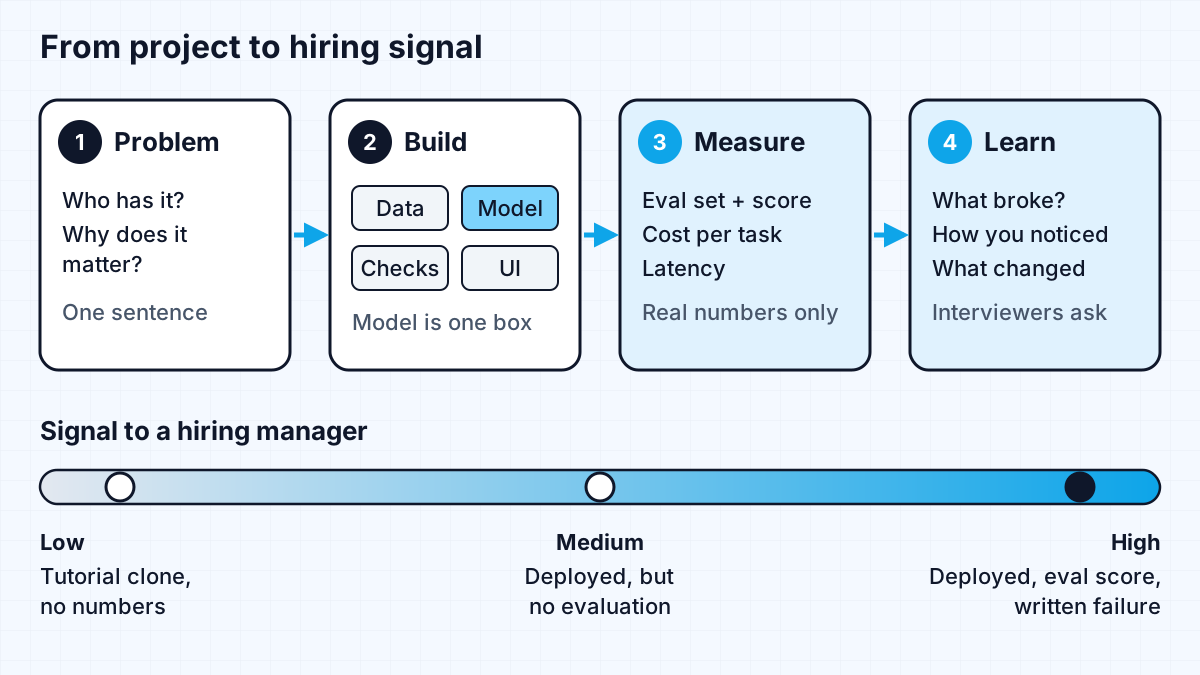
- Problem: one or two sentences on who has the problem and why it matters.
- Approach: the key design decisions, each with the reason behind it.
- Stack notes: what you used and why, briefly.
- Result: the measured outcome. If you do not have a real number, leave it out rather than estimating one.
- What broke: one honest failure and the fix.
- Links: live demo, short video, code.
Two of my case studies show the shape. Avenuor turns a photographed invoice into structured asset data, and the write-up explains why: a model "constrained to a schema, with validation and retry on mismatch" handles endless invoice layouts, and users confirm the extraction, so "the AI proposes and the human commits". AgentOps explains its design decision in one line that an interviewer can probe: nothing moves to the next stage without a person approving it, so an early mistake does not fan out into tickets and code.
My case studies leave out outcome metrics where I do not have verified numbers. That is deliberate. An invented metric is worse than none, because an interviewer will ask how you measured it.
Which projects should you skip?
Skip projects that only prove you followed a tutorial. A reviewer can recognise the common ones on sight, and they crowd out the work that shows judgement. In particular:
- Unmodified tutorial clones. If the README matches a popular course, it signals completion, not ability.
- Notebooks with no deployment. Fine for learning; weak as evidence of engineering.
- Wrappers with no evaluation. A UI around one API call, with no test set and no error handling, shows very little.
- Ten half-finished repos. Two finished, documented projects are better than ten abandoned ones.
- Anything with an exposed API key. It happens more often than you would think, and it ends the review.
Comparing project types at a glance
| Project | What it proves | Effort | Signal |
|---|---|---|---|
| Agent with guardrails | Tool design, permissions, safety | High | Very high |
| RAG with published eval | Retrieval, evaluation discipline | Medium to high | Very high |
| Structured extraction | Schemas, validation, error rates | Medium | High |
| MCP server | Integration, protocol fluency | Medium | High |
| Cost or latency write-up | Production thinking, measurement | Low to medium | High |
| Prompt injection exercise | Security awareness | Low to medium | High |
| Fine-tune with baseline | Modelling judgement | High | Medium |
| Plain chatbot | API familiarity | Low | Low |
How do you get a real user for a portfolio project?
Build for someone specific, even if it is one person. A friend's small business, a community group, your own team at work, or an open-source project with an issue tracker full of real requests. A real user gives you messy inputs, honest feedback and, eventually, a number you did not invent.
If you cannot find a user, use a real public dataset with real mess in it, and build the test set yourself. Then write about what surprised you. My design system MCP server started from a problem I could observe directly: AI coding agents inventing their own spacing, colours and components because they could not see the design system. A problem you can observe is easier to write about honestly than one you imagined.
When you have two or three projects written up this way, rehearse explaining them out loud. My list of AI engineer interview questions is a good set to practise against, because most of them can be answered with "here is what I did on this project".
Work with me
This portfolio is my own worked example: browse my work to see the case-study format in practice. If you need these kinds of systems built rather than demonstrated, see AI agent development and full-stack development, and book a scoping call.
Frequently asked
How many projects should an AI engineer portfolio have?
Two or three finished, well-documented projects are enough for most roles. Each should show a different skill, such as retrieval, agents with tools, or structured extraction, and each should include a measured result and an honest account of what broke.
Do AI portfolio projects need to be deployed?
Deployment is not strictly required, but a live demo or short video makes a big difference because most reviewers will not run your code. If deployment costs are a concern, record a two-minute walkthrough and keep the demo behind a simple usage limit.
Is a chatbot a good AI portfolio project?
A plain chatbot is a weak portfolio project on its own because it is so common. It becomes a strong one when it adds something reviewers rarely see: retrieval with a published eval, tool use with approval steps, or a documented cost and latency optimisation.
Should I use open-source models or APIs in portfolio projects?
Either works, as long as you can explain the choice. Using a hosted API is faster and closer to what most companies do; using an open-weight model shows infrastructure skills. What matters more is that you measure the result and explain the trade-off.
Sources
Related services
Building something like this?
Naman Gundaniya takes on full-stack and AI projects fixed quote after a free 30-minute scoping call, replies within 24 hours.
Get in touch