 By Naman Gundaniya
UAE PDPL and AI Projects: What's Settled and What Isn't
The UAE's federal data protection law, the PDPL, has been in force since January 2022 and already sets consent, objection, impact-assessment and cross-border rules that AI projects must respect. What is not settled is the detail: the executive regulations had still not been issued as of June 2026, and a new federal AI and data authority is expected to shape them. DIFC and ADGM run their own regimes.
If you build AI for a business in Dubai or Abu Dhabi, you will hear two opposite claims about data protection: that the PDPL "isn't enforced yet", and that it was finalised years ago. Both are half right. The law exists and its principles are clear; the rulebook that turns principles into deadlines and procedures is still missing on the mainland, while the financial free zones have detailed rules of their own, including rules written for AI.
This is general information from an engineer who builds AI systems, not legal advice. It sorts what is settled from what is not, and ends with the defaults I use while the gaps remain.
What does the UAE PDPL already require of AI projects?
The PDPL is Federal Decree-Law No. 45 of 2021. Clyde & Co's summary of the law sets out the parts that matter most for AI work. It takes effect on 2 January 2022, and it reaches organisations outside the UAE that process personal data of people inside the UAE, which covers an overseas model provider or developer.
From the same summary, the settled principles are:
- Consent is opt-in and must be "specific, clear and unambiguous". Processing without consent is allowed only on listed grounds, such as performing a contract or meeting a legal obligation.
- There is no "legitimate interests" basis, unlike the GDPR. Teams used to European projects should not assume they can rely on one.
- People can object to automated processing, as well as to direct marketing.
- An impact assessment is required when new technologies pose a high risk to privacy, which is where many AI features land.
- Breaches must be reported to the regulator and the people affected, within a period the executive regulations will set.
- Cross-border transfers are allowed to countries with adequate protection, subject to regulator approval, or under limited exceptions such as express consent or performing a contract.
Clyde & Co also lists the exclusions: government data, health data covered by the ICT health law, banking data governed by its own laws, and companies in free zones that have their own data protection legislation, such as DIFC and ADGM.
What is still not settled?
The executive regulations are the main gap. Morgan Lewis wrote in June 2026 that the PDPL's implementing regulations "have still not been issued", and listed cross-border transfers among the topics they are needed to operationalise. I found no primary source showing they had been issued when I wrote this in November 2026.
That gap matters for timing, not just detail. Clyde & Co notes that controllers and processors get six months from the issuance of the executive regulations to comply, so the regulations will start a clock. They are also expected to set the breach-notification period and sanctions.
The regulator question moved in 2026. Morgan Lewis reports that a Federal Authority for Artificial Intelligence and Data was announced on 14 June 2026. It absorbs the UAE Artificial Intelligence Office, the information and digital government sector within TDRA, and the Emirates Data Office, which the article says "has never became fully operational in practice". The market expects the new Authority to finalise the PDPL regulations, but the article says it is unclear how quickly.
| Question | Status as of late 2026 | Source |
|---|---|---|
| Is the PDPL in force? | Yes, since 2 January 2022 | Clyde & Co |
| Are the executive regulations issued? | Not issued as of June 2026; no primary source found since | Morgan Lewis |
| When must companies comply in full? | Six months after the regulations are issued | Clyde & Co |
| Who regulates mainland data? | Expected to be the new federal AI and data authority; not confirmed | Morgan Lewis |
| Does the PDPL cover DIFC and ADGM firms? | No, they have their own laws and commissioners | Clyde & Co, Morgan Lewis |
| Is there an AI-specific data rule? | In DIFC, yes: Regulation 10 | Mayer Brown |
How do DIFC and ADGM differ for AI?
The free zones are further ahead. Morgan Lewis notes that the DIFC and ADGM Commissioners of Data Protection operate independently and have built active enforcement practices. For AI specifically, DIFC has gone furthest.
Mayer Brown describes DIFC's Regulation 10, introduced in late 2023, which covers personal data processed by autonomous and semi-autonomous systems:
- The deployer, the person "under whose authority or for whose benefit the System operates", is deemed the controller. The operator that runs the system on the deployer's direction is deemed the processor.
- Deployers and operators must give notice at first use of an app or website, covering processing not initiated by humans, whether the system can set its own purposes, and its outputs and safeguards.
- High-risk processing is allowed only if certain conditions hold, such as the system processing data solely for human-defined or human-approved purposes, or an Autonomous Systems Officer being appointed, with a status similar to a data protection officer.
- General certification requirements are expected in future guidance.
If your company sits in DIFC, an AI chatbot or agent on your site is squarely in scope, and the notice is a product requirement, not a footnote.
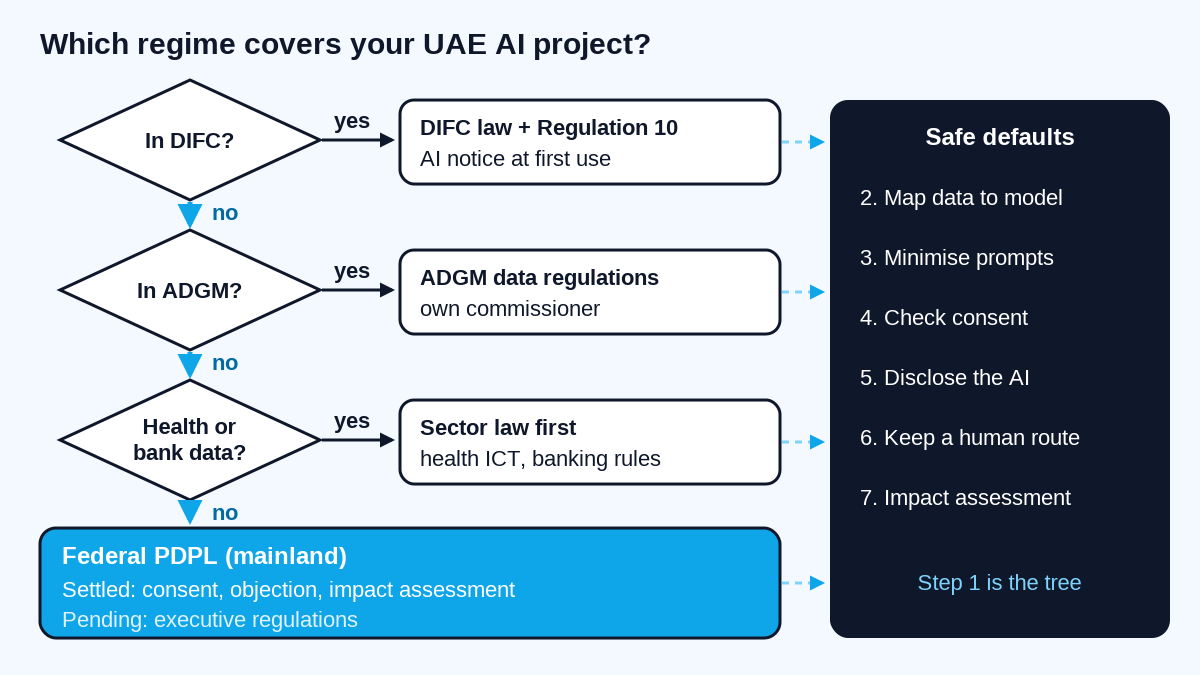
What safe defaults should UAE AI projects use now?
Build for the principles that are already settled, and assume the regulations will add procedure, not loosen anything. These are the defaults I use on AI projects with personal data while the mainland rules are incomplete:
- Find the regime first. Mainland, DIFC, ADGM or a sector law. It changes who you answer to and what notices you need.
- Map what reaches the model. For each feature, list the personal data in prompts, where the provider processes it and whether it is kept or used for training. This feeds the cross-border question.
- Minimise before you send. Strip identifiers the task does not need. A summariser rarely needs a phone number.
- Get consent where you rely on it. With no legitimate-interests basis under the PDPL, check that each use has consent or another listed ground.
- Tell people it is AI. It is required for DIFC Regulation 10 systems and good practice everywhere.
- Keep a human route. People can object to automated processing, so design a way to hand a case to a person. My post on human-in-the-loop AI agents covers the patterns.
- Write the impact assessment now. It is required for high-risk new technology, and it is the document you will want when the regulations arrive.
As a worked example, take a hypothetical mainland retailer adding an AI support assistant to its website. The PDPL applies, because it is not in a free zone with its own law. The assistant sees names, order numbers and sometimes addresses, so step 2 shows personal data going to a model provider abroad: a cross-border transfer. Step 3 removes addresses from prompts, since order status does not need them. The privacy notice explains the assistant and the processing ground, the chat window says it is AI, and a "talk to a person" button covers objections. When the executive regulations arrive, the retailer updates details rather than rebuilding.
Most of this mirrors the GDPR work I describe in GDPR-safe LLM integration, minus the legitimate-interests shortcut. For bilingual customer channels, the same defaults apply to Arabic and English WhatsApp agents, and I covered choosing a consultant in AI consultants for UAE businesses.
Work with me
I build AI features and agents for UAE businesses with data mapping, minimisation, AI disclosure and human handover designed in from the start. There is more on working with me as an AI developer for UAE teams on my UAE page. See AI integration and AI agent development, or browse my work and book a scoping call.
Frequently asked
Is the UAE PDPL enforceable yet?
The law has been in force since 2 January 2022, but the executive regulations that set procedures, deadlines and sanctions had not been issued as of June 2026. Companies get six months from their issuance to comply, so build to the settled principles now rather than waiting.
Does the PDPL apply to companies in DIFC or ADGM?
Not to companies in free zones with their own data protection legislation. DIFC and ADGM each have their own law and commissioner, and DIFC adds Regulation 10 for personal data processed by autonomous and semi-autonomous systems such as AI agents.
Can I send UAE customer data to an AI model hosted abroad?
Possibly, but it is a cross-border transfer. The PDPL allows transfers to countries with adequate protection, subject to regulator approval, and under limited exceptions such as express consent. The detailed transfer rules are among the items still waiting on the executive regulations, so take legal advice for your case.
Who regulates AI and data in the UAE now?
The Federal Authority for Artificial Intelligence and Data, announced on 14 June 2026, consolidates the AI Office, part of TDRA and the Emirates Data Office. It is expected, but not confirmed, to finalise the PDPL regulations. DIFC and ADGM keep their own commissioners.
Sources
Related services
Building something like this?
Naman Gundaniya takes on full-stack and AI projects: fixed quote after a free 30-minute scoping call, replies within 24 hours.
Get in touch