 By Naman Gundaniya
Hiring an AI Engineer Outside the EU: GDPR, SCCs and AVVs
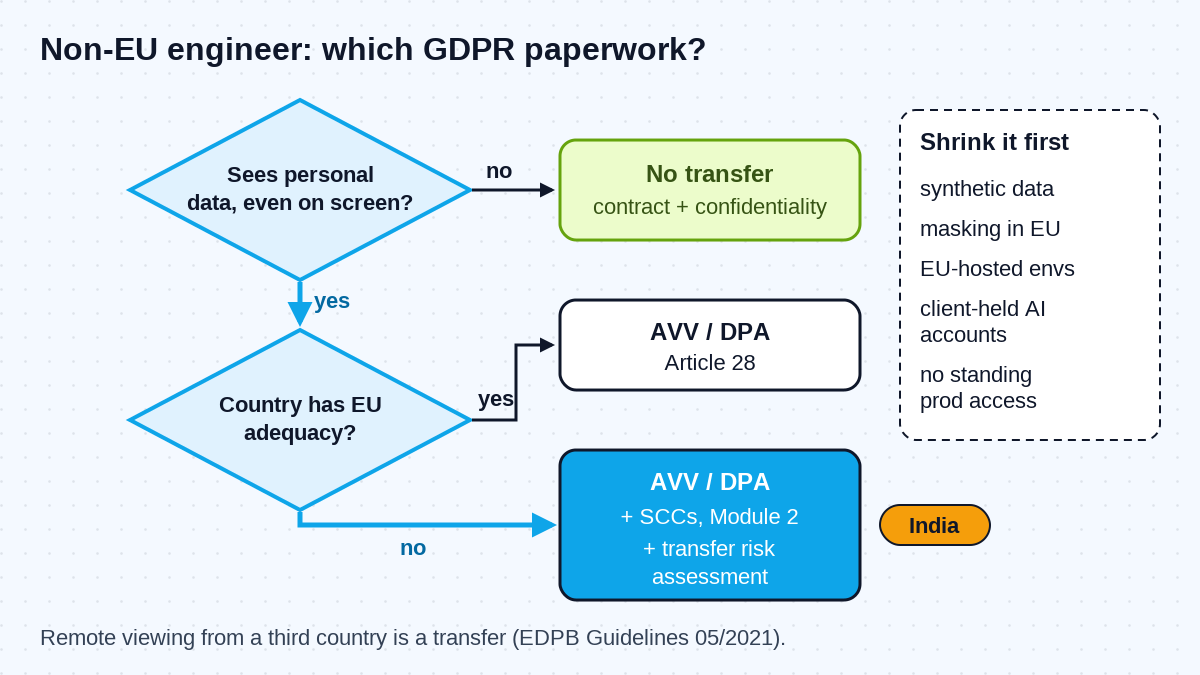
If an AI engineer outside the EU can access personal data you control, GDPR treats that as a transfer, even if they only view it on screen. With an engineer in India, which has no EU adequacy decision, you need a processor agreement (AVV or DPA) and standard contractual clauses, plus a transfer risk assessment. Often the better answer is to give them no personal data at all.
For many EU buyers, the first question about an India-based engineer is some version of "Is it GDPR-compliant to work with someone in India?" The honest answer is that it can be, and that the paperwork is well established. It is also often avoidable, because most AI build work does not need real personal data.
I am an AI engineer based in India and I work in English, so this question applies to me directly. What follows is general information, not legal advice; your data protection officer or lawyer has the final word.
When does working with a non-EU engineer count as a transfer?
It is a transfer when three things are true at once. The European Data Protection Board's Guidelines 05/2021 set out three cumulative criteria: the exporter (you) is subject to GDPR for the processing; you disclose or otherwise make personal data available to another controller or processor (the importer); and the importer is in a third country, whether or not GDPR also applies to them directly.
The detail that surprises people is how little "making available" takes. The same guidelines say that remote access from a third country, "even if it takes place only by means of displaying personal data on a screen, for example in support situations, troubleshooting or for administration purposes", is also a transfer when those criteria are met. Giving a contractor a login to your production database, CRM or support inbox counts.
So the question is not where the server is. It is whether someone outside the EEA can see the data.
Does India have an EU adequacy decision?
No. The European Commission's list of adequacy decisions covers Andorra, Argentina, Brazil, Canada (commercial organisations), the Faroe Islands, Guernsey, Israel, the Isle of Man, Japan, Jersey, New Zealand, the Republic of Korea, Switzerland, the United Kingdom, the United States (for organisations in the EU-US Data Privacy Framework), Uruguay and the European Patent Organisation. India is not on it.
Without adequacy, a transfer needs appropriate safeguards. For a business hiring a contractor, that almost always means the European Commission's standard contractual clauses.
What paperwork do you need?
You need two documents, which can be combined: a processor agreement under Article 28 and the standard contractual clauses.
The AVV or DPA (Article 28). In German this is the Auftragsverarbeitungsvertrag, AVV; in English usually a data processing agreement, DPA. Article 28(3) GDPR lists what it must contain: the processor acts only on your documented instructions, including on transfers; keeps staff bound by confidentiality; applies Article 32 security measures; follows the sub-processor rules; helps with data subject requests and with security, breach and impact-assessment duties; deletes or returns data at the end; and makes available the information needed to show compliance, including audits. The full text of Article 28 also says the processor may not bring in another processor without your prior written authorisation.
The SCCs. The Commission adopted the current clauses on 4 June 2021 in Decision 2021/914. They come in four modules: controller to controller, controller to processor, processor to processor and processor to controller. For a business hiring an engineer to build on its data, Module 2, controller to processor, is the usual fit. Recital 9 of the decision says the clauses also allow parties to fulfil the requirements of Article 28(3) and (4), so a well-drafted SCC set with complete annexes can double as the AVV.
| Document | What it does | Who usually drafts it |
|---|---|---|
| AVV / DPA (Art. 28) | Sets the processor's duties: instructions, confidentiality, security, sub-processors, deletion, audits | The client, from its own template |
| SCCs, Module 2 (Decision 2021/914) | Provides the safeguard for the transfer to a country without adequacy | Standard text; parties fill in annexes |
| Annex II, technical and organisational measures | Describes the actual security controls | The engineer, describing their setup |
| Transfer risk assessment | Records why the SCCs work in practice for this transfer | The client, with input from the engineer |
One nuance worth knowing: the Commission's SCC page describes the clauses as covering importers outside the EEA that are not subject to GDPR, and notes it is developing additional clauses for importers whose processing is directly subject to GDPR. Most India-based contractors working for an EU client are in the first group, but if you are unsure, ask your adviser.
What is a transfer impact assessment?
It is the written check, required by Clause 14 of the SCCs, that the clauses will actually work in the destination country. Before signing, the parties warrant that they have no reason to believe the destination country's laws and practices prevent the importer from meeting its obligations. To give that warranty, Clause 14(b) says they must consider the specific circumstances of the transfer, such as the length of the processing chain, the types of data and where it is stored; the third country's laws and practices on public-authority access; and any supplementary contractual, technical or organisational safeguards.
In practice, the strongest supplementary measure is to keep the data in the EU and limit what crosses the border. That leads to the setup I recommend.
How do you reduce the GDPR exposure in the first place?
Design the engagement so the engineer rarely or never sees real personal data. Most AI build work, such as prompt design, retrieval pipelines, agent tools, evaluation harnesses and the interface, can be done on synthetic or masked data. On client projects I aim for this setup:
- Synthetic or pseudonymised data for development. Realistic test records that contain no real people, generated or masked inside the EU before anything is shared.
- EU-hosted environments. Code, databases and model endpoints in an EU region such as Frankfurt, under the client's accounts. Note that hosting in the EU does not by itself avoid a transfer if someone abroad can still view the data.
- No standing production access. If production debugging is needed, do it with the client on a shared screen, or through time-limited, logged access agreed in advance.
- Model providers under your contracts. The client holds the AI provider accounts and their data processing terms. On AWS, for instance, Bedrock's data protection documentation states that model providers have no access to customer prompts and completions.
- Paperwork anyway, if any access remains. An AVV with SCCs and a short risk assessment cost little compared with the risk of skipping them.
I cover the application side, such as redaction and logging, in my guide to GDPR-safe LLM integration.
Work with me
I work from India, in English, with EU clients' data kept in the EU and paperwork ready when access is needed. See AI integration and AI agent development, read how I compare to agencies in freelance AI engineer vs agency, or browse my work and book a scoping call.
Frequently asked
Is it GDPR-compliant to hire an AI developer in India?
It can be. If the developer will access personal data you control, that is a transfer to a country without an EU adequacy decision, so you need an Article 28 processor agreement, the standard contractual clauses and a transfer risk assessment. If the developer works only on synthetic or masked data and never sees personal data, no transfer takes place.
Does remote access from outside the EU count as a data transfer?
Yes, when the other conditions are met. The EDPB's Guidelines 05/2021 say remote access from a third country, even if the data is only displayed on screen for support or troubleshooting, is a transfer. Where the server is located does not change that.
What is an AVV, and is it the same as a DPA?
An AVV, Auftragsverarbeitungsvertrag, is the German name for the processor contract required by Article 28 GDPR. In English it is usually called a data processing agreement, DPA. They are the same instrument. The standard contractual clauses can also fulfil Article 28's requirements if their annexes are completed properly.
Which SCC module applies when I hire a contractor?
When your business is the controller and the contractor processes personal data on your behalf, Module 2, controller to processor, is the usual choice. If the contractor would decide the purposes of processing themselves, a different module applies, which is a sign the engagement needs a closer look.
Sources
Related services
Building something like this?
Naman Gundaniya takes on full-stack and AI projects: fixed quote after a free 30-minute scoping call, replies within 24 hours.
Get in touch