 By Naman Gundaniya
Arabic AI Agents for Gulf Businesses: Models, Dialects, WhatsApp
An Arabic AI agent for a Gulf business is a customer-facing assistant that understands Modern Standard Arabic, Gulf dialect, Arabizi and English, usually on WhatsApp. The model choice comes down to a test set of your own customers' messages: hosted models such as Claude or GPT, or open-weight regional models such as Falcon-H1 Arabic, Jais 2 or ALLaM, which you can host in-country.
I work with clients in the UAE, and the questions about Arabic agents are always the same three. Will it understand how our customers actually write? Should we use a model built in the region? And can it run on WhatsApp, where our customers already are? This post answers each one with what the vendors and Meta publish, as of late 2026. I have not shipped an Arabic-language agent myself, so treat this as a build and evaluation plan, not a case study.
Why is Arabic harder for an AI agent than English?
Arabic is harder because the language customers type is rarely the language models are benchmarked on. Formal writing uses Modern Standard Arabic (MSA). Customer messages in Dubai or Riyadh mix Gulf dialect, English words, voice notes and Arabizi, which is Arabic written in Latin letters and digits ("3" for ع, "7" for ح).
That gap matters for three parts of an agent:
- Understanding. A model that scores well on MSA exams can still misread a short dialect message about a delivery or a booking.
- Replying. Most businesses want replies in clear MSA or a light Gulf register, not heavy dialect. That is a tone decision for you, not the model.
- Retrieval. If your knowledge base is in English and the customer writes in Gulf Arabic, search has to work across languages, or the agent answers from nothing.
Benchmarks help less than they appear to. Anthropic's multilingual support page reports Claude Opus 5.5 scoring 99.3% of its English score in Arabic on Global-MMLU. That is a strong result, but Global-MMLU is a formal knowledge test. It tells you little about a three-word Arabizi message asking whether your shop is open during Eid.
Which models handle Arabic well in 2026?
There are two groups: global hosted models, which are strong in MSA and easy to call by API, and regional open-weight models trained with more Arabic and dialect data, which you can run on your own infrastructure. Names and versions change quickly, so here is what each developer's own pages say as of November 2026.
| Model family | Who builds it | What the developer publishes | How you use it |
|---|---|---|---|
| Falcon-H1 Arabic | Technology Innovation Institute (TII), Abu Dhabi | 3B, 7B and 34B sizes; up to 256K tokens of context; MSA plus Gulf, Levantine, North African and Egyptian dialects (TII, TII on Hugging Face) | Open weights to host yourself; a public chat demo |
| Jais 2 | Inception (G42), MBZUAI and Cerebras | 8B and 70B open-weight models released December 2025, with dialects in the Arabic fine-tuning data (Cerebras) | Open weights on Hugging Face; Jais Chat app |
| ALLaM | SDAIA's NCAI, published under HUMAIN's account (Saudi Arabia) | ALLaM 7B Instruct preview: Arabic and English, 4,096-token context (model card) | Open 7B weights; Microsoft and HUMAIN say they "intend to" offer ALLaM in Microsoft Foundry (Microsoft) |
| Claude | Anthropic | Arabic at 98.3-99.6% of English on Global-MMLU across current models (Anthropic) | Hosted API, also through major clouds |
| GPT | OpenAI | Not benchmarked here; check OpenAI's current model docs | Hosted API, also through Azure |
Two cautions. First, the regional figures are the developers' own benchmarks, such as TII's Open Arabic LLM Leaderboard results. Second, ALLaM's 4,096-token context is small for an agent that carries a long system prompt, tool definitions and chat history, so check the newest version before you plan around it.
Should you choose a regional model or Claude and GPT?
Choose on three things in this order: where the data has to live, how each model does on your own messages, and how much work you can take on to run it. "Built in the Gulf" is not by itself a reason to pick a model, and neither is brand familiarity.
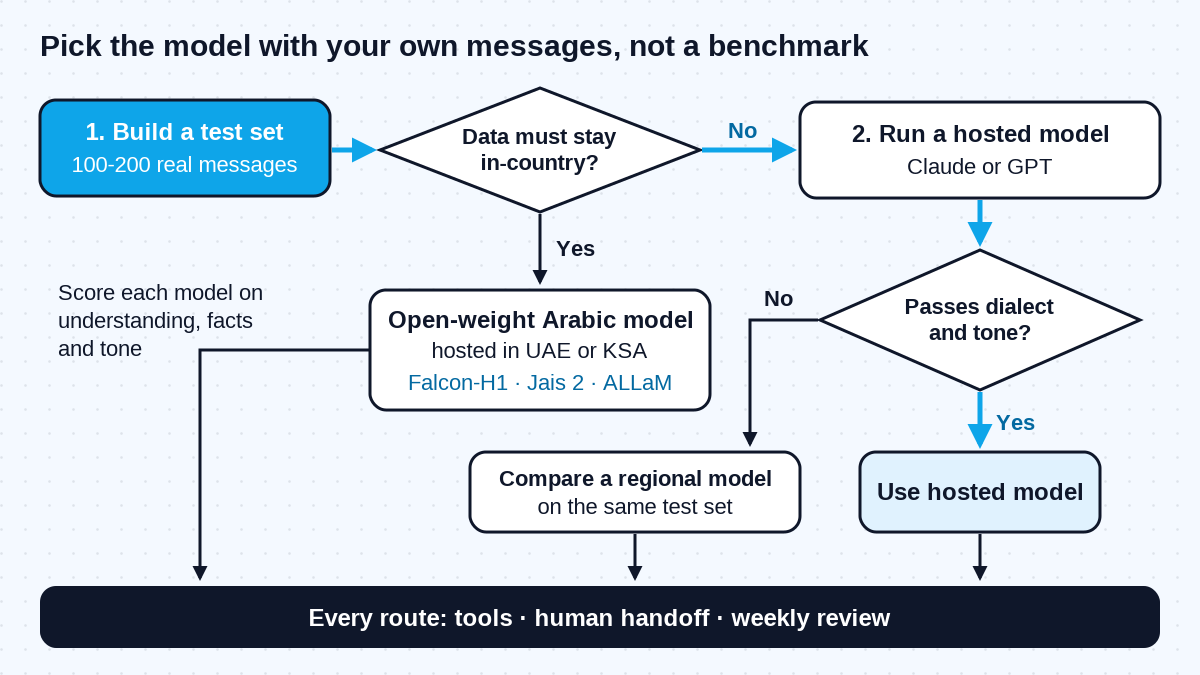
Data location. Saudi Arabia and the UAE both have personal data protection laws, and some sectors (government, health, finance) add their own rules. If your counsel says the conversation data must stay in the country, an open-weight model on in-country servers is the cleanest route. A hosted model can still work if a cloud region in the country offers it, but confirm that for the exact model you want. This is legal advice territory; get it from a lawyer, not from a blog.
Quality on your messages. Build a test set of 100 to 200 real customer messages, anonymised: dialect, Arabizi, mixed Arabic and English, typos, short angry ones. Write the reply you would want for each. Then run every candidate model against it and score understanding, correctness and tone. My guide to the evals that keep agent projects on track covers how to score this without fooling yourself.
Running effort. A hosted API is a key and a bill. An open-weight model needs GPU servers, updates, monitoring and someone who owns them. I compare the trade in open-source LLMs vs an API. For many businesses a hybrid is the practical answer: a hosted model for the conversation, with sensitive lookups done in your own systems so the personal data never reaches the prompt.
How do you run an Arabic agent on WhatsApp?
You run it on the WhatsApp Business Platform as an assistant for your own business, with templates for anything you send first and a clear route to a person. Meta's WhatsApp Business Platform terms (last modified September 23, 2026) prohibit AI providers from using the platform when the AI is the main functionality on offer, and name "general-purpose artificial intelligence assistants" among the technologies covered. A Dubai clinic's booking assistant is incidental to the clinic, so it is allowed. A "chat with our Arabic AI about anything" number is not.
The same terms say WhatsApp Business Platform data may not be used to train or improve AI models, except fine-tuning a model for your exclusive use. That matters if you plan to fine-tune a regional model on past chats: keep it yours alone.
The WhatsApp Business Messaging Policy adds the day-to-day rules: you need opt-in before you message someone, "you may only initiate conversations using an approved Message Template", and automation inside the 24-hour window must come with "prompt, clear, and direct escalation paths", such as a transfer to a human agent.
For Arabic agents, I would add four design rules:
- Write templates in both languages. Plan Arabic and English versions of every reminder and confirmation template from the start, and submit both for approval.
- Detect the language per message, reply consistently. Customers switch mid-conversation. Decide the rule (reply in the language of the last message, MSA for Arabic) and put it in the system prompt.
- Hand off with a summary in the agent's language of record. Your staff may read English better than dialect; a short English summary for them saves time.
- Handle voice notes honestly. Many customers send them instead of typing. Either transcribe them with a speech model you have tested on Gulf speech, or ask the customer to type and offer a human.
The general build, from webhook to handoff, is in my WhatsApp AI agent build guide.
What does it cost to run an Arabic WhatsApp agent?
The running cost is Meta's per-message charges plus model usage, and Arabic changes the second part more than the first. Meta's pricing page charges per delivered message by category and recipient country, gives each business number 1,000 free service messages a month, and since October 1, 2026 charges service messages beyond that.
On the model side, the same message can use a different number of tokens in Arabic than in English, and hosted APIs bill per token. Measure it on your test set instead of guessing. On a self-hosted model the cost is the servers, whatever the token count, so high volume can favour open weights while low volume almost always favours an API. Build cost depends on scope, and I quote that after a scoping call rather than in a blog post.
Work with me
I design and build AI agents and WhatsApp assistants, including the evaluation set that decides which model is good enough. See AI agent development and AI chatbot development, read about working with UAE companies, or browse my work and book a scoping call.
Frequently asked
Can an AI agent understand Gulf Arabic dialect?
Often, yes, but test it rather than trust a benchmark. Claude reports strong Arabic results on formal tests, and TII lists Gulf dialect in Falcon-H1 Arabic's training. Neither guarantees good results on your customers' short, mixed messages, so score each model on 100 to 200 real examples first.
Is Falcon, Jais or ALLaM better than Claude or GPT for Arabic?
There is no general answer. Regional models were trained with more Arabic and dialect data and can be hosted in-country; Claude and GPT are easier to run and strong in MSA. Pick the one that scores best on your own test set within your data rules.
Are Arabic AI chatbots allowed on WhatsApp Business?
Yes, if the AI supports your own business, such as bookings, orders or support. Meta's terms prohibit providers whose main offering is a general-purpose AI assistant, require approved templates for business-initiated messages, and require a clear path to a human.
Does the agent have to reply in Arabic?
No. Many Gulf businesses reply in the customer's language, switching between Arabic and English. State the rule explicitly in the system prompt, because models otherwise drift between languages and registers in a long conversation.
Sources
- multilingual support page (platform.claude.com)
- TII (falconllm.tii.ae)
- TII on Hugging Face (huggingface.co)
- Cerebras (cerebras.ai)
- model card (huggingface.co)
- Microsoft (news.microsoft.com)
- WhatsApp Business Platform terms (facebook.com)
- WhatsApp Business Messaging Policy (whatsappbusiness.com)
- pricing page (developers.facebook.com)
Related services
Building something like this?
Naman Gundaniya takes on full-stack and AI projects: fixed quote after a free 30-minute scoping call, replies within 24 hours.
Get in touch